
Hello all,
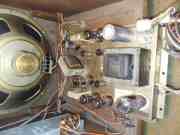
Well, I re-capped this little amp, and sure enough,
the spectre of a pronounced 120 hz hum is there.
It's not a normal string-heater hum, but louder.
I need to remove the amp again from the cabinet, as I
wanted to do a test run with the Zenith all re-assembled.
The hum is volume dependent on both R/L channels.
The volume control will exhibit some weird
squelching when rotated.
I have cleaned all controls.
I unplugged the audio leads from tonearm to amp,
and hum remains.
Tubes: 12AX7 and two 50EH5 ouput.
Tophat silicon rectifier tested good, so I left it in.
Resistors checked well WNL.
I know the 50EH5 tubes could be noise culprits, and
they tested functional on a little Mercury tester.
My Precision 1012 tester does not have a data
listing for a 50EH5.
I need to develop a standard troubleshooting procedure
for these string-heater amps, since the tabletop record
players I like usually have them.
I have not checked the ceramic capacitors yet.
1959 Zenith 3 Tube Stereo 120 Hz Hum Plague
-
Hi-Fi-Mogul

- Anchor Member
- Posts: 1358
- Joined: Sat Jul 10, 2021 1:53 am
- Contact:
-
hermitcrab

- Anchor Member
- Posts: 1504
- Joined: Mon Jul 12, 2021 2:49 am
- Location: Tri Cities Mich
- Contact:
Re: 1959 Zenith 3 Tube Stereo 120 Hz Hum Plague
I hate these type of problems.. sounds like a job for the ole oscilloscope if you got one ...I would be surprised if it was a ceramic cap... but I have seen where they have been a culprit , but is rare. Not familiar with the 50EH5 tube issues , I do have a small GE that uses them, but it plays fine...I know that tube gets pushed to the limit on voltages ... grid leak?
-
Hi-Fi-Mogul
- Anchor Member
- Posts: 1358
- Joined: Sat Jul 10, 2021 1:53 am
- Contact:
Re: 1959 Zenith 3 Tube Stereo 120 Hz Hum Plague
I hope to get a couple of NOS 50EH5's to sub out.hermitcrab wrote: ↑Tue Sep 07, 2021 9:59 pm I hate these type of problems.. sounds like a job for the ole oscilloscope if you got one ...I would be surprised if it was a ceramic cap... but I have seen where they have been a culprit , but is rare. Not familiar with the 50EH5 tube issues , I do have a small GE that uses them, but it plays fine...I know that tube gets pushed to the limit on voltages ... grid leak?
I'll run some voltage checks, which I should have
already done.
I don't have a scope, but maybe one day, if I can learn to
use it well.
I think about 50-60% of these type amps I repair, end up
with AC hum beyond what is acceptable.
Maybe I can get a troubleshoot portfolio created here. [ : )
Hi-Fi-Mogul
-
electra225

- Site Admin
- Posts: 9026
- Joined: Thu Jul 08, 2021 7:48 pm
- Location: San Tan Valley, AZ
- Contact:
Re: 1959 Zenith 3 Tube Stereo 120 Hz Hum Plague
The 50EH5 is a souped-up version of a 50C5. The 50C5 will sub if you have some. They use the 50EH5 in record players because it doesn't take as much input signal to drive them to full output. After you run your voltage measurements and are sure they are okay, paying special attention to the cathode voltage. Check the cathode bias resistors, both 68 ohms on the schematic. They need to be pretty much spot on.
Is it possible that the sound you are hearing is not a hum, per se, but some type of oscillation? The reason I mention this is that you have a noise when you move the volume control. Hum is seldom generated ahead of the volume control. It is typically generated in the power supply. It can be found in a radio, since there is a front end ahead of the volume control. On your record player, all there is ahead of the volume control is the phono input. Secondly, Zenith is notorious for having squeals and motorboating in its audio. This due to the fact that there are typically no cathode bypass capacitors used. Your particular chassis uses the output filter cap for bypass duty. I'm wondering if this is inadequate. My suggestion would be to bridge the output filter cap, listed at 20uf on the schematic with an electrolytic of equal or greater working voltage and greater capacity, say 47 or even 68uf. OBSERVE POLARITY then just use test leads connecting the test cap across the existing filter cap. See if the noise goes away, changes or diminishes. I would increase the capacity of the input filter cap to 100 uf if it was mine. Zenith gets real skimpy on their filtering. If the filtering is inadequate, you might get more noise as you increase the volume, be it hum or an oscillation of some kind. Since the noise is in both channels, I wouldn't suspect the tubes. Wiggle tubes in their sockets, clean the volume and tone controls well. Then take a non-metalic stick of some kind and poke and pound on connections under the chassis.
Is it possible that the sound you are hearing is not a hum, per se, but some type of oscillation? The reason I mention this is that you have a noise when you move the volume control. Hum is seldom generated ahead of the volume control. It is typically generated in the power supply. It can be found in a radio, since there is a front end ahead of the volume control. On your record player, all there is ahead of the volume control is the phono input. Secondly, Zenith is notorious for having squeals and motorboating in its audio. This due to the fact that there are typically no cathode bypass capacitors used. Your particular chassis uses the output filter cap for bypass duty. I'm wondering if this is inadequate. My suggestion would be to bridge the output filter cap, listed at 20uf on the schematic with an electrolytic of equal or greater working voltage and greater capacity, say 47 or even 68uf. OBSERVE POLARITY then just use test leads connecting the test cap across the existing filter cap. See if the noise goes away, changes or diminishes. I would increase the capacity of the input filter cap to 100 uf if it was mine. Zenith gets real skimpy on their filtering. If the filtering is inadequate, you might get more noise as you increase the volume, be it hum or an oscillation of some kind. Since the noise is in both channels, I wouldn't suspect the tubes. Wiggle tubes in their sockets, clean the volume and tone controls well. Then take a non-metalic stick of some kind and poke and pound on connections under the chassis.
I haven't failed. I've just found 10,000 ways that won't work.....Thomas Alva Edison
-
Hi-Fi-Mogul
- Anchor Member
- Posts: 1358
- Joined: Sat Jul 10, 2021 1:53 am
- Contact:
Re: 1959 Zenith 3 Tube Stereo 120 Hz Hum Plague
Greg,
Thank you SO much for your insights again.
I really enjoy learning the helpful in's & outs and details
you hi-fi veterans can offer about electronics.
The particular Zenith info is very interesting to me.
Now, instead of a bit of frustration, I can have some fun
doing detective troubleshooting !
I'll get back with Sam Spade's report.
Thank you SO much for your insights again.
I really enjoy learning the helpful in's & outs and details
you hi-fi veterans can offer about electronics.
The particular Zenith info is very interesting to me.
Now, instead of a bit of frustration, I can have some fun
doing detective troubleshooting !
I'll get back with Sam Spade's report.
Hi-Fi-Mogul
Re: 1959 Zenith 3 Tube Stereo 120 Hz Hum Plague
It's interesting that Zenith in the '60s, so renowned for TOL TV design and construction in that time period at least, a fact which is almost universally acknowledged by those who are much more in-the-know than I, seemed to penny pinch in some of their consoles, at least as may be evident here. Wonder if they just considered console audio low priority in comparison to the vast and growing TV market.
-
electra225
- Site Admin
- Posts: 9026
- Joined: Thu Jul 08, 2021 7:48 pm
- Location: San Tan Valley, AZ
- Contact:
Re: 1959 Zenith 3 Tube Stereo 120 Hz Hum Plague
Magnavox was recognized in the 1960's as a leader in audio. Their FM tuners were adequate, but not much more. Zenith was king of the hill in FM and TV. Audio was their Achilles heel. Some of their audio stuff was right down horrid. The TV guys call Magnavox TV's "Maggotbox" so there is no love lost there. Zenith built some bullet-proof TV sets, no doubt. When I was 13, I started working for a TV guru who only worked on Zenith and Magnavox. He made a good living selling and working on Zenith, so they would break occasionally. He had a contract with the local furniture store who sold Magnavox, so he worked on them. He liked their audio stuff, but not so much their TV sets.
I'm interested in learning what Mr. Mogul finds with this chassis. Even those little cheap GE stereos I have all have cathode bypass caps in them, right down to the cheapest one they built. I wonder what would happen if we created cathode bypass caps for that chassis? Paralleled say 50uf @ 50 volt caps with those 68 ohm bias resistors. The schematic says 2 volts on the cathodes, so that's running those output tubes pretty hard.
I'm interested in learning what Mr. Mogul finds with this chassis. Even those little cheap GE stereos I have all have cathode bypass caps in them, right down to the cheapest one they built. I wonder what would happen if we created cathode bypass caps for that chassis? Paralleled say 50uf @ 50 volt caps with those 68 ohm bias resistors. The schematic says 2 volts on the cathodes, so that's running those output tubes pretty hard.
I haven't failed. I've just found 10,000 ways that won't work.....Thomas Alva Edison
-
hermitcrab
- Anchor Member
- Posts: 1504
- Joined: Mon Jul 12, 2021 2:49 am
- Location: Tri Cities Mich
- Contact:
Re: 1959 Zenith 3 Tube Stereo 120 Hz Hum Plague
My big SS Magnavox Imperial has a low hum in the amplifier , the second you turn it on , it is very low , compare it to a guitar amp with nothing plugged in , I have went through the entire amp, including new power supply caps ... hum still there, only thing I have not checked it the remote control box where the output travels though ... other than that once music starts even at low volume you can't hear it at all... so not too concerned about it...I just tell people it is the raw power... 
-
electra225
- Site Admin
- Posts: 9026
- Joined: Thu Jul 08, 2021 7:48 pm
- Location: San Tan Valley, AZ
- Contact:
Re: 1959 Zenith 3 Tube Stereo 120 Hz Hum Plague
I had a Zenith 5-S-56 that would intermittently squeal like a pig in a buzz saw. Never did fix it. I sold it like most of my other Zenith radios. I have bad luck with Zenith for some reason. Like all the other manufacturers, they had their good and bad.
Edit.....I checked the schematics for a couple of my little GE's that were in Don's collection. The ones with hot chassis use 100uf input filters and 70uf output filter caps. And they all have 20uf at 25 volt cathode bypass caps as well. These are the little PCB chassis, no where near the quality that Zenith was renowned for with their hand-wired metal chassis.
Edit.....I checked the schematics for a couple of my little GE's that were in Don's collection. The ones with hot chassis use 100uf input filters and 70uf output filter caps. And they all have 20uf at 25 volt cathode bypass caps as well. These are the little PCB chassis, no where near the quality that Zenith was renowned for with their hand-wired metal chassis.
I haven't failed. I've just found 10,000 ways that won't work.....Thomas Alva Edison
-
Motorola minion
- Anchor Member
- Posts: 854
- Joined: Sun Jul 11, 2021 2:23 pm
- Location: Central PA
- Contact:
Re: 1959 Zenith 3 Tube Stereo 120 Hz Hum Plague
I have just read this thread for the first time, possibly due to all the other interesting activity on this site.
The Zenith three-tube looks like a copy of a 1963 Magnavox portable I just worked on and gave back already, and had the very same issue with this repair. I was able to make it sound better than new (I suspect) because the amp was poorly re-designed from day one, when key parts were unavailable.
I agree the 50EH5 is driven hard with 2 volts dropped across cathode resistors and with no bypass/decoupling caps* (added 50mf@25v across each), bass suffers greatly. This is a no-brainer upgrade with single 8" speakers, to play a stereo record without the small-box sound of a typical portable.
50EH5 cathode voltages were too high at 3.5v , so resistors were changed to 47 ohms from 56. That brought both to 2.5v, and without a distortion analyzer, I cannot say for certain but it sounded a whole lot better to me.
*Omission of bypass caps allows some "degeneration of music signal" across that cathode resistor, providing a function of reducing distortion.
The hum issue was bad too! It went away quickly as volume was reduced to minimum but as the only resistance between grids (G1) and B- on the 12AX7, a powerful signal was being added at the volume pot or from tonearm wiring and cartridge feeding the high side, all suspects.
The power supply was a single silicon diode with a 22-ohm current limiting resistor and additionally, the Magnavox has adequate 120 mf and 80 mf filter caps were not part of the hum issue, strangely.
Referencing Sams, this one had used non-center-tapped output transformers and non-tapped volume pots, though schematic showed them as such. The tapped primary is a hum-reducing feature similar to a filter choke in most big amps, isolating the G2 of each 50EH5 from the bass-induced variations in B+ feeding into the output transformer primary.
I swear it was built the same way as the Zenith, after looking at the schematic, I see C11 that attempts to decouple B-minus(ground symbol) from the "shield" chassis (fork symbol).
Yes, the phono cart common goes via .047 mf to B- and to chassis, done to isolate tone-arm.
Just do this: add a 47mf / 250 volt electrolytic across C11 and like the Mag, you may just fix it that way. As a pre-caution replace the plug with a polarized one as I see your Zenith runs one side of line mains to B- (not chassis).
The Zenith three-tube looks like a copy of a 1963 Magnavox portable I just worked on and gave back already, and had the very same issue with this repair. I was able to make it sound better than new (I suspect) because the amp was poorly re-designed from day one, when key parts were unavailable.
I agree the 50EH5 is driven hard with 2 volts dropped across cathode resistors and with no bypass/decoupling caps* (added 50mf@25v across each), bass suffers greatly. This is a no-brainer upgrade with single 8" speakers, to play a stereo record without the small-box sound of a typical portable.
50EH5 cathode voltages were too high at 3.5v , so resistors were changed to 47 ohms from 56. That brought both to 2.5v, and without a distortion analyzer, I cannot say for certain but it sounded a whole lot better to me.
*Omission of bypass caps allows some "degeneration of music signal" across that cathode resistor, providing a function of reducing distortion.
The hum issue was bad too! It went away quickly as volume was reduced to minimum but as the only resistance between grids (G1) and B- on the 12AX7, a powerful signal was being added at the volume pot or from tonearm wiring and cartridge feeding the high side, all suspects.
The power supply was a single silicon diode with a 22-ohm current limiting resistor and additionally, the Magnavox has adequate 120 mf and 80 mf filter caps were not part of the hum issue, strangely.
Referencing Sams, this one had used non-center-tapped output transformers and non-tapped volume pots, though schematic showed them as such. The tapped primary is a hum-reducing feature similar to a filter choke in most big amps, isolating the G2 of each 50EH5 from the bass-induced variations in B+ feeding into the output transformer primary.
I swear it was built the same way as the Zenith, after looking at the schematic, I see C11 that attempts to decouple B-minus(ground symbol) from the "shield" chassis (fork symbol).
Yes, the phono cart common goes via .047 mf to B- and to chassis, done to isolate tone-arm.
Just do this: add a 47mf / 250 volt electrolytic across C11 and like the Mag, you may just fix it that way. As a pre-caution replace the plug with a polarized one as I see your Zenith runs one side of line mains to B- (not chassis).
-
Motorola minion
- Anchor Member
- Posts: 854
- Joined: Sun Jul 11, 2021 2:23 pm
- Location: Central PA
- Contact:
Re: 1959 Zenith 3 Tube Stereo 120 Hz Hum Plague
Motorola minion wrote: ↑Thu Sep 23, 2021 3:37 pm I have just read this thread for the first time, possibly due to all the other interesting activity on this site. I just had that same issue as Hi-Fi Mogul.
The Zenith three-tube looks like a copy of a 1963 Magnavox portable I just worked on and gave back already, and had the very same issue with this repair. I was able to make it sound better than new (I suspect) because the chassis 80-01-10 amp was poorly re-designed from day one, becoming an 80-02-20 (!) when key parts were unavailable. I love Magnavox but....sometimes they got in a bind and compromised.
Greg - I agree the 50EH5 is driven hard with 2 volts dropped across cathode resistors and with no bypass/decoupling caps* (added 50mf@25v across each), bass suffers greatly. This is a no-brainer upgrade with single 8" speakers, to play a stereo record without the small-box sound of a typical portable. In the Mag, 50EH5 cathode voltages were too high at 3.5v , so resistors were changed to 47 ohms from 56. That brought both to 2.5v, and without a distortion analyzer, I cannot say for certain but it sounded a whole lot better to me.
*Omission of bypass caps allows some "degeneration of music signal" across that cathode resistor, providing a function of reducing distortion. This is better done with feedback from 50EH5 plate or speaker OPT winding fed back via cap and resistor to the alter preamp tubes cathode bias. I am not up to doing THAT much to improve this little amp.
The hum issue was bad too! It went away quickly as volume was reduced to minimum but as the only resistance between grids (G1) and B- on the 12AX7, a powerful signal was being added at the volume pot or from tonearm wiring and cartridge feeding the high side, all suspects.
The power supply was a single silicon diode with a 22-ohm current limiting resistor and additionally, the Magnavox has adequate 120 mf and 80 mf filter caps were not part of the hum issue, strangely.
Referencing Sams, Mag later used non-center-tapped output transformers and the schematic showed that variation. The tapped primary is a hum-reducing feature similar to a filter choke in most big amps, isolating the G2 of each 50EH5 from the bass-induced variations in B+ feeding into the output transformer primary. The volume-control tap allows bass-boosting pre-emphasis at low volumes, also missing on this later run.
I swear it was built the same way as the Zenith and, after looking at the schematic posted, see C11 attempting to decouple B-minus(ground symbol) from the "shield" chassis (fork symbol).
Yes, the phono cart common goes via .047 mf to B- and to chassis, done to isolate tone-arm.
Start by jumping a 47mf / 250 volt electrolytic across C11 and if greatly improved like the Mag, you may just leave it that way. As a pre-caution replace the line cord plug with a polarized one as I see your Zenith runs one side of line mains to B- (not chassis).
-
Hi-Fi-Mogul
- Anchor Member
- Posts: 1358
- Joined: Sat Jul 10, 2021 1:53 am
- Contact:
Re: 1959 Zenith 3 Tube Stereo 120 Hz Hum Plague
Hello guys,
Thanks Dave for more insight on this little amp,
and the curious Magnavox parallel.
I'm about ready to put this Zenith back on the table
to do the voltage checks. Then the capacitor
upgrade temp wire-in to see what happens.
This means "organizing" my work table, ha ha !
Well, at least moving things off to the side.
Thanks Dave for more insight on this little amp,
and the curious Magnavox parallel.
I'm about ready to put this Zenith back on the table
to do the voltage checks. Then the capacitor
upgrade temp wire-in to see what happens.
This means "organizing" my work table, ha ha !
Well, at least moving things off to the side.
Hi-Fi-Mogul
-
Hi-Fi-Mogul
- Anchor Member
- Posts: 1358
- Joined: Sat Jul 10, 2021 1:53 am
- Contact:
Re: 1959 Zenith 3 Tube Stereo 120 Hz Hum Plague
Here's some results of troubleshooting so far.
1. Adding extra e-lytic filter caps made no
difference at all.
I did not try Moto Minion's C11 cap suggestion yet.
I wonder if he meant C10.
As C11 is a line to chassis cap, that I used
a 0.01 mF X1Y2 cap as replacement.
2. Observations:
When DMM probe attached to
Pin 2 (grid) of 12AX7A, there occurred a noise
like a low squeal of a saw cutting on wet metal.
This occurred with volume up, and no noise with
volume all the way down.
Would this be oscillation ?
Wooden chopstick probing around inside of tube
sockets and all wiring produced no noise or pops.
When I attached a wire to chassis and to the tone arm
cartridge ground wire that connects to (C10) 0.047mF,
there was a slight reduction in hum.
2. Voltages & resistor value
V2 50EH5
Pin 1 K 2.3 V (2 V)
Pin 6 Screen 93 V (80 V)
Pin 7 Plate 146 V (135 V)
Cathode resistor (R7) 82 ohms (68 ohms)
V3 50EH5
Pin 1 K 2.4 V (2 V)
Pin 6 Screen 95 V (80 V)
Pin 7 Plate 150 V (135 V)
Cathode resistor (R11) 79 ohms (68 ohms)
12AX7 (A)
Pin 1 Plate 59 V (60 V)
Pin 2 Grid - 0.74 V (- 0.5 V)
12AX7 (B)
Pin 6 Plate 59 V (60 V)
Pin 7 Grid - 0.64 V (- 0.5 V)
1. Adding extra e-lytic filter caps made no
difference at all.
I did not try Moto Minion's C11 cap suggestion yet.
I wonder if he meant C10.
As C11 is a line to chassis cap, that I used
a 0.01 mF X1Y2 cap as replacement.
2. Observations:
When DMM probe attached to
Pin 2 (grid) of 12AX7A, there occurred a noise
like a low squeal of a saw cutting on wet metal.
This occurred with volume up, and no noise with
volume all the way down.
Would this be oscillation ?
Wooden chopstick probing around inside of tube
sockets and all wiring produced no noise or pops.
When I attached a wire to chassis and to the tone arm
cartridge ground wire that connects to (C10) 0.047mF,
there was a slight reduction in hum.
2. Voltages & resistor value
V2 50EH5
Pin 1 K 2.3 V (2 V)
Pin 6 Screen 93 V (80 V)
Pin 7 Plate 146 V (135 V)
Cathode resistor (R7) 82 ohms (68 ohms)
V3 50EH5
Pin 1 K 2.4 V (2 V)
Pin 6 Screen 95 V (80 V)
Pin 7 Plate 150 V (135 V)
Cathode resistor (R11) 79 ohms (68 ohms)
12AX7 (A)
Pin 1 Plate 59 V (60 V)
Pin 2 Grid - 0.74 V (- 0.5 V)
12AX7 (B)
Pin 6 Plate 59 V (60 V)
Pin 7 Grid - 0.64 V (- 0.5 V)
- Attachments
-
Hi-Fi-Mogul
-
Motorola minion
- Anchor Member
- Posts: 854
- Joined: Sun Jul 11, 2021 2:23 pm
- Location: Central PA
- Contact:
Re: 1959 Zenith 3 Tube Stereo 120 Hz Hum Plague
As unorthodox as it sounds, the 47 mf between chassis and B minus is your C11 and the C13 below, lower left
I have no idea why this worked on the Magnavox but with such a freakishly simple circuit of high gain stages made it so 
- Amp 80-02-20.jpg (88.43 KiB) Viewed 6382 times
-
Hi-Fi-Mogul
- Anchor Member
- Posts: 1358
- Joined: Sat Jul 10, 2021 1:53 am
- Contact:
Re: 1959 Zenith 3 Tube Stereo 120 Hz Hum Plague
I don't doubt your solution. I did have a question aboutMotorola minion wrote: ↑Tue Sep 28, 2021 10:16 pm As unorthodox as it sounds, the 47 mf between chassis and B minus is your C11 and the C13 below, lower left.
I have no idea why this worked on the Magnavox but with such a freakishly simple circuit of high gain stages made it so.
polarity placement for the 47 mF cap b/t chassis & B minus.
Would negative side of e-lytic cap go to B minus side ?
Thanks !
Hi-Fi-Mogul
-
Motorola minion
- Anchor Member
- Posts: 854
- Joined: Sun Jul 11, 2021 2:23 pm
- Location: Central PA
- Contact:
Re: 1959 Zenith 3 Tube Stereo 120 Hz Hum Plague
Yes, that is what I did, negative to B-. I could not measure any DC so its probably moot. AC measured was only a few volts (even my Fluke 177 seemed confused). Of course we made sure the player itself was connected to signal ground as well, but probably compounding the issue.
The metal/shielded chassis seems like a no-brainer ground for a cartridge "low side" AND with high gain and coupling to B-, which is the 12AX7 preamp's input reference ground, the cap is intended to "bypass" or "de-couple" AC noise and "signal ground" back to B-. Two major producers have done it, Ill look at some RCA and GE few-tube portable schematics.
This mystery is not yet solved but I suspect the isolation was a UL requirement until polarized plugs (post tube equipment) somewhat resolved it.
This is rather odd, but I never had the same issue in a AC/DC radios wired similarly (except for the high-gain amp). The record player may have always had this very annoying issue because it was like new condition otherwise, rarely seen on 50+ YO equipment.
The metal/shielded chassis seems like a no-brainer ground for a cartridge "low side" AND with high gain and coupling to B-, which is the 12AX7 preamp's input reference ground, the cap is intended to "bypass" or "de-couple" AC noise and "signal ground" back to B-. Two major producers have done it, Ill look at some RCA and GE few-tube portable schematics.
This mystery is not yet solved but I suspect the isolation was a UL requirement until polarized plugs (post tube equipment) somewhat resolved it.
This is rather odd, but I never had the same issue in a AC/DC radios wired similarly (except for the high-gain amp). The record player may have always had this very annoying issue because it was like new condition otherwise, rarely seen on 50+ YO equipment.
-
Hi-Fi-Mogul
- Anchor Member
- Posts: 1358
- Joined: Sat Jul 10, 2021 1:53 am
- Contact:
Re: 1959 Zenith 3 Tube Stereo 120 Hz Hum Solved
Okay, I re-routed the green lead off of the balance
control which went to G2 of a 50EH5.
It was near the AC lines.
I also bent the tophat rectifier away from the
balance control.
A friend of mine had suggested those actions.
That reduced the hum some.
Then with the new 47 mF 250 V cap in place, the
hum is greatly reduced.
Thanks !!!!
I will put a polarized AC cord on, also.
Would it be of any value to place the X1Y2 cap back
in parallel with the 47 mF e-lytic ?
control which went to G2 of a 50EH5.
It was near the AC lines.
I also bent the tophat rectifier away from the
balance control.
A friend of mine had suggested those actions.
That reduced the hum some.
Then with the new 47 mF 250 V cap in place, the
hum is greatly reduced.
Thanks !!!!
I will put a polarized AC cord on, also.
Would it be of any value to place the X1Y2 cap back
in parallel with the 47 mF e-lytic ?
- Attachments
-
-
Hi-Fi-Mogul
-
Motorola minion
- Anchor Member
- Posts: 854
- Joined: Sun Jul 11, 2021 2:23 pm
- Location: Central PA
- Contact:
Re: 1959 Zenith 3 Tube Stereo 120 Hz Hum Plague
As to a X2 cap, it should just go across the AC line, because there is no isolation transformer here.
I understand why a chassis to one side of line must be a Y2 but I only use them in transformer sets from each side of line to chassis.
I looked at schematics for other players like VM-311, same issue may be there too.
I understand why a chassis to one side of line must be a Y2 but I only use them in transformer sets from each side of line to chassis.
I looked at schematics for other players like VM-311, same issue may be there too.
-
electra225
- Site Admin
- Posts: 9026
- Joined: Thu Jul 08, 2021 7:48 pm
- Location: San Tan Valley, AZ
- Contact:
Re: 1959 Zenith 3 Tube Stereo 120 Hz Hum Plague
I'm sorry to abandon your project, Mr. Mogul. I'm glad you got it sorted. I took a little unexpected vacation......
I haven't failed. I've just found 10,000 ways that won't work.....Thomas Alva Edison
-
Hi-Fi-Mogul
- Anchor Member
- Posts: 1358
- Joined: Sat Jul 10, 2021 1:53 am
- Contact:
Re: 1959 Zenith 3 Tube Stereo 120 Hz Hum Plague
Greg, you did not abandon the project, and Dave was anotherelectra225 wrote: ↑Sun Oct 03, 2021 6:15 pm I'm sorry to abandon your project, Mr. Mogul. I'm glad you got it sorted. I took a little unexpected vacation.....
wise counselor in addressing the problem.
Again, I learned a LOT from this little Zenith amp.
Next in line is the Decca "The Douglas" PP 50C5 mono amp that I believe
needs some good socket cleaning, tubes double checked and
solder joints checked.
My friend really did a good repair job on the poor little cabinet
that was dropped in shipment apparently.
I'll post photos when I get that started.
Hi-Fi-Mogul
Who is online
Users browsing this forum: No registered users and 2 guests