

Conelrad posted the following about power supply design in another thread:
"With AC power in a rectifier situation, here is what happens:
Line voltage rectified into DC with a cap-input filter will be 1.4114 (peak to peak waveform) times the line E. Current available will be limited as you approach the point of the filters ability to provide the smoothing effect. Circuit voltage will vary widely under load.
Line voltage rectified into DC with a choke-input filter will be .707 (RMS waveform) times the line E. Current and voltage available will hold up under variable load until total overload."
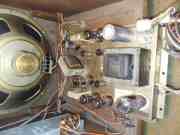
Most of my electronics with filter chokes--most often speaker field coils--aren't choke input. They are cap-choke-cap. How do those behave?
And with regard to the quote above, what's the cap-input voltage ratio for RMS?
Chris Campbell
AC to DC
-
Conelrad

- Hero Member
- Posts: 270
- Joined: Tue Feb 07, 2023 4:28 am
- Location: Hidden Valley, AZ
- Contact:
Re: AC to DC
C-L-C filters are a good deal, with some of the benefits of simpler filters combined.
RMS ratio is always .707 X E for expected DC result with sine wave input. 120 would equal 85 volts.
D
RMS ratio is always .707 X E for expected DC result with sine wave input. 120 would equal 85 volts.
D
-
Motorola minion
- Anchor Member
- Posts: 845
- Joined: Sun Jul 11, 2021 2:23 pm
- Location: Central PA
- Contact:
Re: AC to DC
Cap-Inductor-cap is by definition an "M-derived" low-pass filter. I have some equipment that omit this important component needed in a tubed high-fidelity audio power supply. Not all amps use this method, relying instead on resistors to isolate current drain from sources that must remain more constant.
Early radio used conveniently available speaker field coils and OPT "hum buck" taps to provide the reactive component needed for a power supply to ride-out transients and provide maximum power to the speaker.
The inductor literally resists current change in such an instantaneous way that heavy bass doesn't get "tubby" (aka poor transient response) because plate voltage was limited by power supply loading rather than tube conduction.
Solid state equipment in comparison is ALL about current sources, so transistor regulators are used in the power supplies, cheaper than inductor-chokes.
Early radio used conveniently available speaker field coils and OPT "hum buck" taps to provide the reactive component needed for a power supply to ride-out transients and provide maximum power to the speaker.
The inductor literally resists current change in such an instantaneous way that heavy bass doesn't get "tubby" (aka poor transient response) because plate voltage was limited by power supply loading rather than tube conduction.
Solid state equipment in comparison is ALL about current sources, so transistor regulators are used in the power supplies, cheaper than inductor-chokes.
Who is online
Users browsing this forum: No registered users and 28 guests