While I'm not out of the woods yet, by any means, I'd like to share some observations I have made during this process.
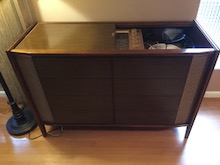
First, Magnavox built this stereo with "sizzle, but no steak". Built for a home you would see on Perry Mason, with tall ceilings, wool carpet, heavy draperies, classical or easy-listening music. Built with beautiful hardwood cabinetry (although not finished on the bottom of the cabinet). The bean counters were hard at work killing Magnavox when this stereo was built. They used a 15 or 20-watt amplifier, so boomy bass is not likely because of the flea-power amp. Second, Magnavox bought and used the cheapest garbage parts they could find, utilized generous tolerances, producing a "sloppy and slushy" amplifier. Enthusiasts complain about wimpy bass. In reality, what this one was producing was wimpy FIDELITY. Wimpy bass was only a part of that. When this stereo was new and all the cheap parts were new, it probably sounded pretty good, good enough to get paid and get it out the door. The last 64 years has not been kind to this old stereo. It was a high-hour set when I got it and I have used it heavily myself.
90% of the resistors I have changed during this process were within the factory tolerance of 15%. They were mismatched between channels. The reason I bought the resistor kit was so I could have multiple resistors of the same value so I could find two that closely matched. The "big three" plate load, grid load and cathode bias resistors were matched between channels and are all less than .1% off spec and less than that different between channels. There are four resistors in the amp chassis that are still original. I even replaced the resistors in the feedback circuit so they would be the same. I selected resistors so the "difference" in value between channels would be "on the same side" of the specification. If one was 30 ohms high, the other is similar. I didn't put one high and one low.
I believe, at this point, my recommendation for any Magnavox bi-amp is matched output tubes. If you have a CG, you will need two sextets and one quad of matched JJ 6V6's about $480 worth. This Imperial has a quad and a pair of matched tubes, and I asked that the quad and the pair be matched. They recommended that the treble amp tubes need not be as stout as the bass channel tubes. The treble amp tubes are matched at 29ma, the bass amp tubes at 37ma. There are mathematical equations about audio that I don't understand. From a "mechanical" perspective, I am holding my own, I guess.
I love my Magnavox stereos. I believe Magnavox was king of the hill in console stereos and audio in general in their day. They have beautiful cabinetry, cad-plated chassis that look like new 64 years after they were built. The wiring is sloppily oriented, but it appears to be excellent quality, resting on hot tubes for decades with no apparent damage. They have features and doodads galore, but by the time this stereo was built, they used really cheap parts that have not aged well. If you want your old Magnavox stereo with bi-amps to sound as good as it can, you need to do a component-by-component restoration of the electronics, keeping the tolerances to 5% or less. Then you should spring for some balanced tubes. Output, audio and rectifiers. Keep the component tolerances the same between channels. Match resistors between channels. You essentially need to do what Magnavox did when they built it. Do it part by part.......


Life can be tough. It can be even tougher if you're stupid.....




 Maybe somebody will run over them with heavy equipment. Note to self.....NEVER use horns for test. NEVER.....